Hello fellow travellers and hi to new subscribers.
Welcome one and all to another Friday Newsletter. Feedback Friday.
Feedback is critical, and...
Big news: I’ve finished the prequel novella to the Spectral Detective Series, Into Darkness, and it’s now in beta! I’m inviting you, my fellow travellers, to read it and share your feedback to help shape this thrilling tale.
Into Darkness thrusts a battle-hardened operative into a WWII mission where ancient relics spark spectral chaos. Think Jack Reacher’s grit, James Bond’s daring, and Indiana Jones’ relic-hunting bravado in a shadowy world of ghosts and secrets.
Reply to join the beta reader mission team.
At the moment, the Spectral Detective is taking up my time, and I am pushing on with the first novel; I break away from that to be here.
Writing in a period requires research; sometimes, the hours I wasted as a kid watching old movies come in very useful. However, movies and television can distort reality by replaying tropes that don't reflect how things really are. Getting shot and carrying on, and say brawling—is often unrealistic.
Immersing in a period, getting scents and sound beats, is also fun, and since I write in the third-person limited omniscient, or in plainer English, I chose to write from one character's perspective, what they sense, as noted in last week’s Newsletter. In the past, the third-person omniscient narration dominated, with an all-knowing narrator, the writer, explaining things.
I read Pride and Prejudice well into adulthood, having seen film and television adaptations before the book, and this remains true for most of Charles Dicken's works too.
What I remember of reading Austen is that her style is proto-modern, with exposition that is economical, distinct from Dickens, who tends to lean into long, even meandering descriptions of places.
Austen “shows” through social interactions, such as balls and conversations, rather than “telling” through extended summaries. For instance, in Pride and Prejudice, we learn about Darcy’s wealth and personality through gossip and Elizabeth’s reactions, while she does shift to the thoughts of others—for example, Mr Darcy, Elizabeth Bennet's inner world takes priority.
World-building on a cosmic scale is something I find in the Infinite Void series. "The Survivors" is a short story set in the far-future Infinite Void space opera series by Richard Rimington. In a galaxy teeming with cyberpunk empires and existential threats, a powerful figure known as the Ambassador confronts the looming collapse of humanity. She recruits resilient individuals, including cybernetic warriors like Belara, battling cosmic threats in her ambitious crusade. The story unfolds with intense battles, advanced technology, and a vision for humanity’s survival, setting the stage for a sprawling interstellar saga.
While that seems a galaxy far, far away from Pemberly, the tools that writers use to transport you to a different place or time remain the same.
"The Survivors"
by Richard Rimington
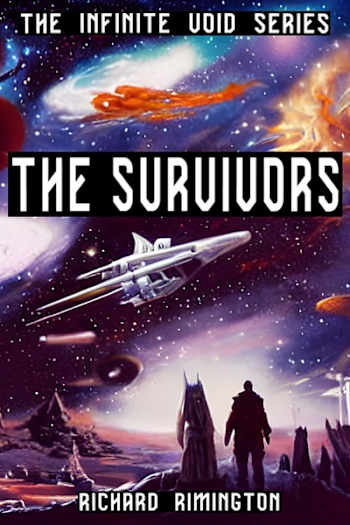
In this tale of space opera and cosmic adventure, the Ambassador of a mysterious and ancient family must forge a path through chaos to overcome the terrible enemies that desire humanity’s destruction.
Her plan to avert galactic catastrophe will unite a band of survivors who have faced every imaginable danger and disaster.
This story forms a prologue to the Infinite Void series.
"The Survivors" |