Imagined emotions, muddy drafts, plot holes, and the long ride home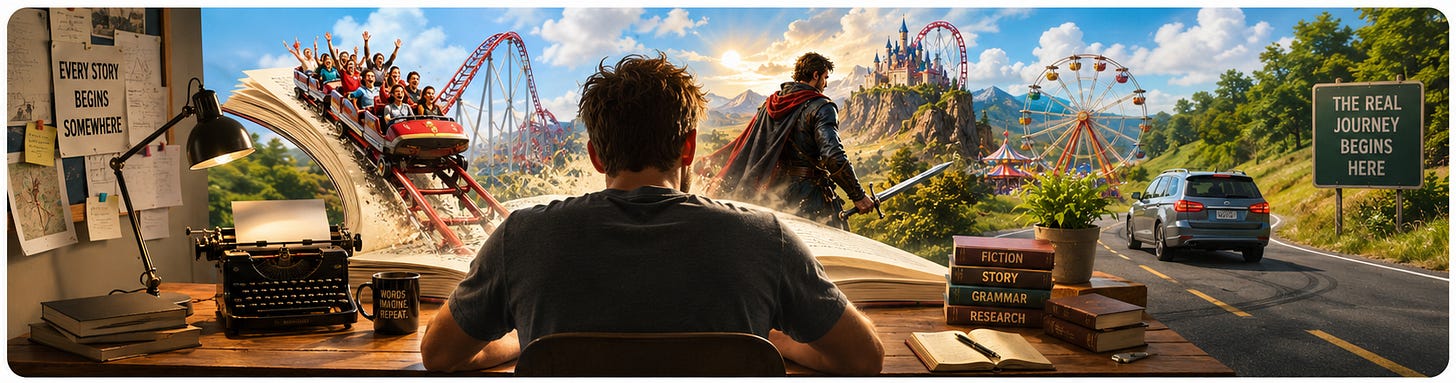
Imagined Emotions
Writing is the business of imagined emotions. Writers are dealers, indulging in their own drug of choice.
Our brains fire in a chemical soup, and whether we’re reading another writer’s inventions or dallying in our own, the subconscious rolls along, not caring whether the thrills are real or imagined.
The rollercoaster ride at the fair presents a false sense of danger, and the body, at this primal level, reacts, blurring the line between fear and excitement.
When we imagine Random Hero doing their derring-do against the darkness that threatens, we’re aware of reality, but still we are thrilled, if the author does their job, right?
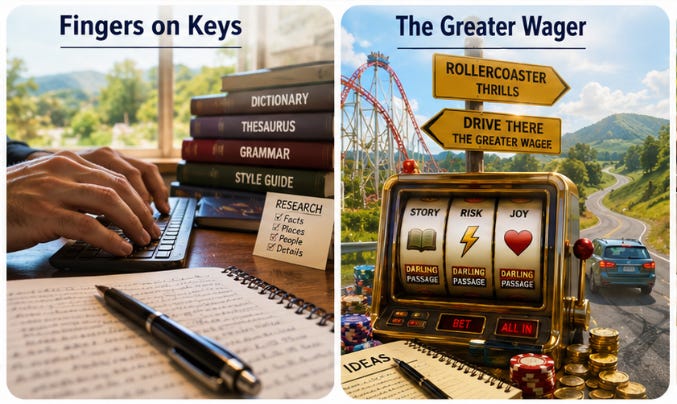
Writing is work; it’s a practice of fingers on keys, tappity-tap.
There are rules of spelling, grammar, and convention, as well as research. Factual history—both present and past—matters, but a writer learns how words can work together by reading fiction.
How to elicit that emotional fix that both the producer and consumer demand.
Mud on the Page
Everything in life requires energy. The brightness of creativity wanes when the mind tires, but it’s also the emotional state of the artist.

Like rolling out of bed, going on a run can feel horrid, but then twenty minutes later, in the cold driving rain, with mud up to your knees, it feels wonderful—a runner’s high.
Writing is the deliberate act of putting words down on the page.
It’s getting down and dirty in a virtual world. It’s not always great prose; sometimes it is mud on the page.
Life is a gamble: a walk, a run, even the rollercoaster carries risk, though the drive there may pose the greater wager.
The act of storytelling becomes a slot machine. I might be down, tired, or disaffected, eking out prose, a hard slog; or I could brim with enthusiasm—joyous and effortless writing. Both can become “darling” passages that might have to die so that the story can breathe.
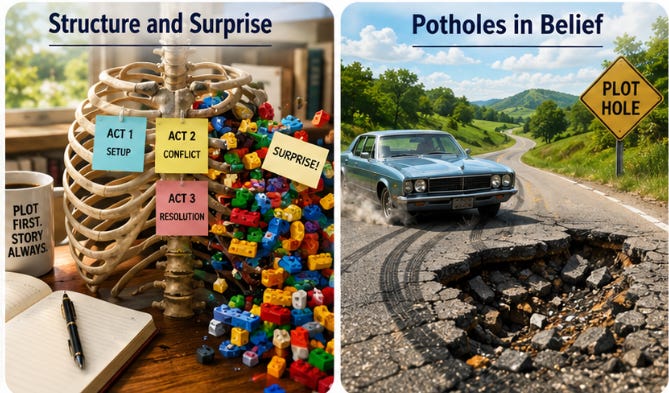
For me, writing is more than the sentence on the page. I enjoy plotting—creating the skeletal structure on which the meat of the story hangs. I vacillate between a strong, but never rigid, plot outline and what they call writing by the seat of one’s pants, or pantsing, to be cute.
No matter how complete my plot outline, I won’t stop a strong idea because it breaks the preordained structure I have in my head. Sometimes that idea has a shape, forcing itself into the plot; other times it’s a deep, dark hole.
Plot holes are like potholes in the road for our suspension of disbelief. Once experienced, they rattle the subconscious’s wishbones. This shakes both the heart and the mind. Without deft course correction, both writer and reader are on a journey neither might finish. Remember, kids, steer into the skid…
All the Way to The End
Plotting can help avoid the realisation that thousands of words are worthless. The only crime might be mundanity—it doesn’t advance the narrative. Other times it raises a more fundamental question: why would my character do this? For example, a child adrift in the world will not make the same decisions that a lost adult would. Here, there is a balance to be struck between trusting the reader and explaining enough, and it’s a subtle—instinctive.

My weakness as an author is one of closeness to the characters and the story. What is obvious to me, knowing the people in the world I imagine, may not be obvious to the reader. The art lies in striking the balance between revelation and suspense, because suspension of disbelief hangs between the two. The reader expects a ride, whether that’s a rollercoaster or a cosy swing seat—it’s my job to keep them with me for a while, all the way to The End.
© C J Charles 2026