The difference between assistance and authorship
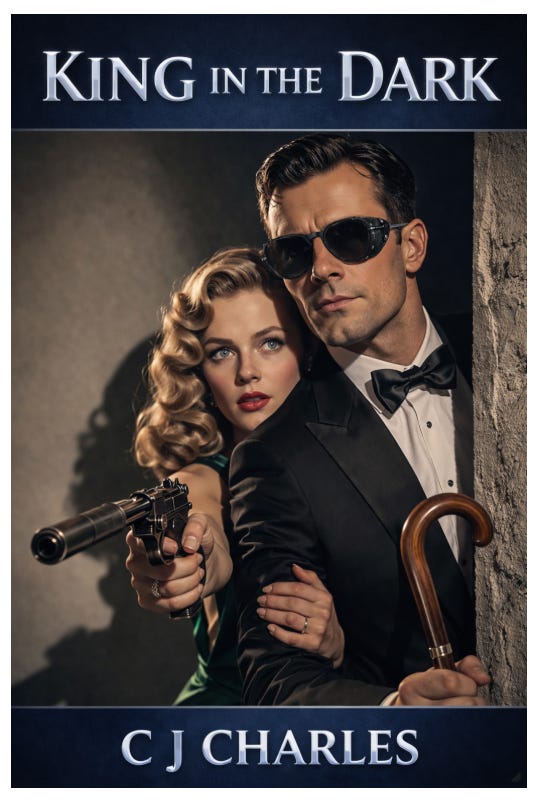
Reading through King in the Dark as a complete work before I commit to a print edition. So far, so good!
I’m more accurate than I was when I first self-published; however, that’s mostly down to the better tools available today. Also, I am blessed by helpful beta-readers, who bring a necessary human overview.
What I bring to the table is not the promise that I don’t use tools to help me, but rather, that the one doing the creative writing is me. Technology improves my technical accuracy, dealing with speeling-errors, and spotting waterlemons.
Assistance includes data to inform: what day was July 4th, 1664? (Wednesday).
Be little old me, at school, poring over the Encyclopaedia Britannica, I might skip-read or misread a block of text.
Today, I could skim and miss a data point in an online Wiki.
AI is not a panacea; it gets things wrong, too, both actively and passively, e.g., failing to mention key details that matter, as New Year’s Day fell on March 25th from the 12th century until 1752, in England and her colonies.
I can draw, but I am no pro. Life is about “economic choice,” how I spend my time. If I am doing one thing, I am not doing another, and those creative hours, for me, are about writing, researching, building my notes and plots. So, I use AI to help build covers. I take base images and edit them using software, utilising these tools to get the result I want. For quick illustrations, the kind I drop into my Newsletter and articles, I often choose the best from the batch AI generates without editing.
Some folks object to AI vehemently. Yesterday, I came across an interesting post on X, formerly known as Twitter. A user posted a picture of a genuine work of art...
i just generated an image in the style of a Monet painting using AI please describe, in as much detail as possible, what makes this inferior to a real Monet painting
The thread has multiple users coming in and critiquing. Granted, some may have been tongue-in-cheek, recognising the jape, but it’s clear many thought this artwork to be “slop”, which is the in-vogue label for sloppy AI imagery or prose. Nature reports that labelling artwork as AI-generated triggers a negative bias, causing people to devalue it—even when the image is identical to one labelled human-made.
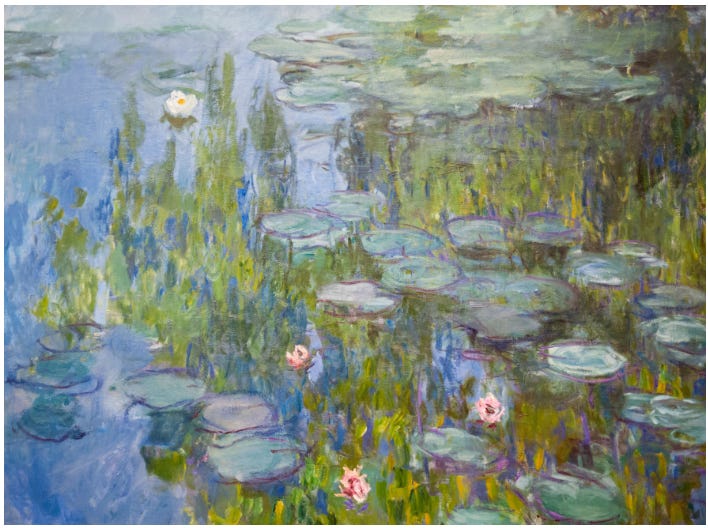
— (Water-Lilies, c.1915, catalogue no. W.1796)
I don’t rate AI’s writing as a general rule. I like my own choices. They are, after all, my voice; here is an allegory.
AI can generate dozens of images from a single prompt.
I find it generally goes: 20% = bad, 60% = fair, and 20% = okay. Outstanding happens, but only as an exceptional outcome, some of the time.
The same is true for text. Am I biased against AI’s turn of phrase, as the reviewers proved toward the Monet?
I think so, but the crucial difference is that they didn’t paint that picture.
Whereas I am choosing my voice over another’s.
My work is human because I filter everything through me. Just as a boy, I used the Britannica to learn what Henry VIII did in 1509 for my written homework. Decades later, AI can brief me about the world in 1943 or 1643. I sift this data to inform my fiction, to be historical, but what AI cannot do is create the story I want to tell, because that lies in my soul, my imagination.