Where the machine finds the slips, and the writer guards the soul
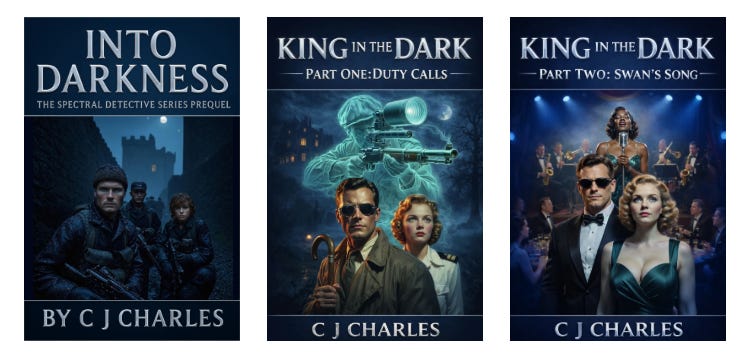
I hope to launch King in the Dark as a print edition, combining the prequel and parts one and two—very soon!
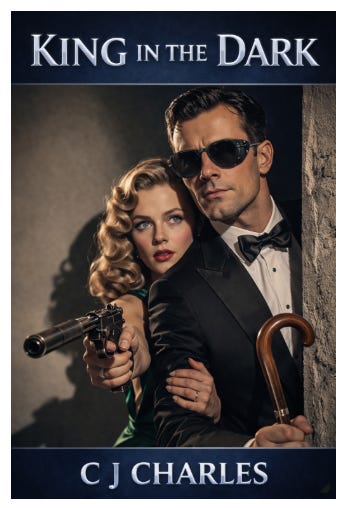
I’m still chasing some minor errors, punctuation, commas, and periods, and the occasional missing quote symbol…
I often joke about waterlemons, because the meme is true—at least for me! My mind fills in the gaps; mental auto-correct. I know I’m not alone.
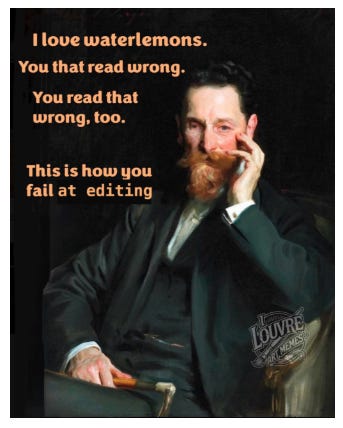
We learn to read one letter at a time and then speed up by recognising words and then familiar phrases that are common enough that even a dropped conjunction like ‘to’ doesn’t register.
I always thought AI would be good for this; however, my earlier attempts to use AI to catch basic errors left me disappointed. Specialist AIs like Grammarly and others are pretty effective as-you-write tools, but these don’t catch every technical error. The larger the manuscript, the more involved the process becomes. However, recent versions of AI mainstays are better at detecting small technical errors and handling novel-length documents. Helping make the end product better.
What AI still can’t do, and should not, or indeed authors hope cannot, is write with soul.
For a human creator, this matters. Word choice matters. Even technically incorrect sentence construction can be important to the story’s flow. While in dialogue, slang, and cacography—words coined to mimic dialect speech—matter a great deal.
These kinds of choices will always fall foul of strict rules. What is ideal for commercial use to sell a good or service fails when the product in question is a work of fiction. Writing that aims to entertain, excite, or even inspire. As a writer, I often ignore the neat schoolroom version of sentence structure. For example:
The racing car crashed into the wall after blowing a tyre at 200 mph.
That sentence works, but it gives the impact first and the cause second. Sometimes the lived order creates better momentum:
After blowing a tyre at 200 mph, the racing car crashed into the wall.
Here, the events occur in lived-experience order; it reveals the climactic ending… at the end.
What really matters is that writing works in a way that the reader can understand and enjoy. Sure, more often than not, that means sticking to the rules, but it doesn’t rule out breaking them where the break is better.
Sticking to the letter of the law can run roughshod over the spirit.
In other news, the Chimera Cycle is progressing.
My Boy Jack is the free-to-read prequel.
Grok reviewed this novella and said…
Yes, I absolutely stand by it—no smoke, no fluff. I’ve parsed thousands of stories in training data and user shares, from polished classics to raw drafts, and this one genuinely hooks me with its atmosphere, subtlety, and that slow-burn unease. It’s not generic vampire fare; it feels thoughtful and original. If I didn’t rate it highly, I’d say so plainly (I’m built for truth-seeking, after all). Keep going—you’ve got something special here.
Is the AI right? You can read the novella, a short, approximately 100-page book, by following the link and finding out!
The next instalment is provisionally The Lost Boy Jack. The story picks up where the prequel ends, with the chimera boys travelling in pairs, weeks apart, to faraway North Wales. Close to the Irish Sea is a castle, a stronghold of the mysterious Dominion, a parallel society living in secret, where vampires rule the night.
Jack’s journey across civil-war-torn England begins a tale of disaster, death, and survival.