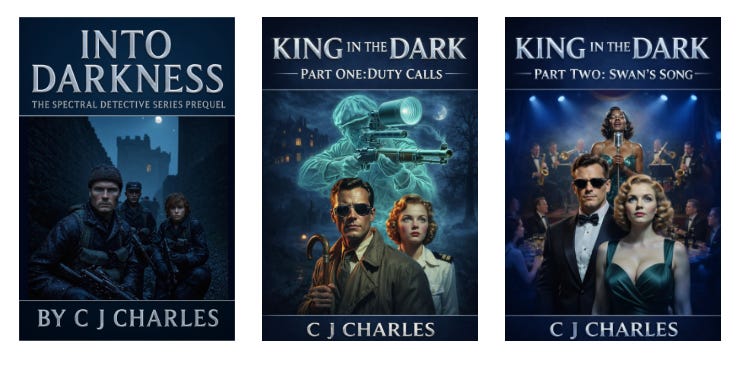
Three times around… Re-reading King in the Dark Part Two, before launching the book. A necessary work.
So what does that look like?
Every author develops their own way of doing things. I reckon, absent a randomised controlled trial... that two people could have almost identical approaches, and create very different works. Tone, style and genre. I’m just as sure another pair might create similar stories using diametrically opposing methods.
Methods are often defined this way: by the seat of your pants, or pantsing versus planning, that is, plotting.
This newsletter, dear reader, is being pantsed. That means I am sitting down and just winging it, it’s not quite true ‘sit down with a blank page and mind,’ I have a frame: what I have been doing since my last newsletter.
That slides the pointer a little to the right towards plotting, because I have a vague idea of where I am going with this…
Plotting begins with writing those initial ideas down and then expanding on them.
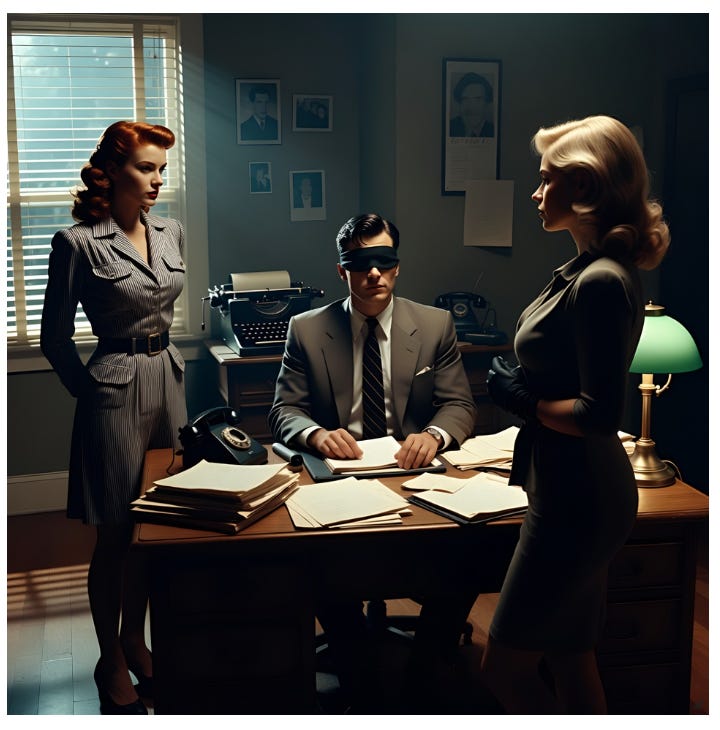
King in the Dark started with a dream. A blind detective, a noir hero vibe, a female partner, and a Nazi agent as a client.
As a writer, I began my first attempt at a novel-length story as a pantser, making things up as I went along, but that only took me so far. Plotting helped be get to the end of my first book.
I find working out what happens at the beginning, in the middle, and at the end to be a creative virtuous circle…
Five W questions… who, what, when, where, why, w’how?
Character bio(graphy)s for who, and location bio(graphy)s for where inspire new ideas; they also give me guardrails, something I found out when I drew and painted, the more things and colours I threw at the page, didn’t result in a prettier picture.
The plot skeleton needs fleshing out; the writing part. Here, I find the pointer slides back towards pantsing, as I make things up and find a new, better idea.
When I wrote the conclusion to King in the Dark, I thought my ‘act three’, my ending well thought through. However, when I came to write it, sorting out who is doing what, when, and where, proved more complex.
Word processors flag most spelling and grammar mistakes by underlining; it’s easy to fix them on the go. When I complete a chapter, I run some basic writing checks, such as flagging repeated words.
Some jiggery-pokery goes on with the earlier chapters as I finish the later ones.
It’s fair to say that if I counted how many times I’ve read individual chapters... it would be tens of times!
Still a full read-through of the whole demands I get to “The End” that is a first draft of the book!
Re-reading... I expect to lose about 10% of the total word count. That’s a net count, as I am rewriting, adding new material, and cutting.
Distance helps. Sometimes lines of text feel right, and yet days or weeks later, this “darling” seems clunky or even inane.
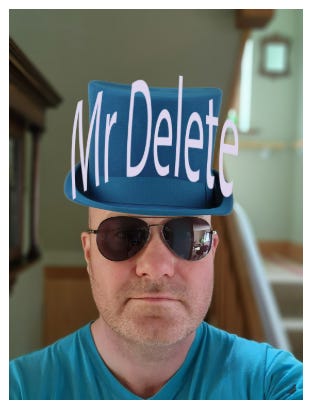
I don my Mr Delete Hat and go for it.
My first re-read of the whole is more about the quality of the writing. The second re-read is less brutal in terms of changes. Edits themselves can introduce errors, so a second look re-polishes.
If I’ve done an okay job of one and two, three is error checking with minimal cuts and rewrites.
What this means, dear reader, is King in the Dark Part Two — Swan’s Song is really coming soon. Thanks again to my beta readers; you know who you are.