Research.
When I first decided to write a Fantasy Novel, I did so with the childish expectation it would be easier.
Hey, teen me, said to himself, all I need to do is make stuff up. It's fantasy, so it is.
I'd twisted my ankle when I stood on a pebble on a concrete floor, and my foot shot out from under me. I just happened to be carrying a hundredweight of sacks of seed for sowing on my shoulder. So, I did a proper job of hobbling myself.
After deciding to write a world where I controlled history and geography, I chose to give my world a time and a place, albeit one where I still had control—the antediluvian world.
This is BI: Before the Internet. I had a big old Atlas, an Apple IIe, an imagination, and a mind full of fiction and speculation. I looked at "Atlantis" ideas, such as Antarctica before the ice. I don't remember when I settled on the Levant, but by the late 1990s, ten years on, both this location and the Internet were in play.
Later, when I finally finished the story that is Dragons Unleashed, I'd been online nearly as long as I had lived when I made my first stab at a novel, so around 18 years!
Google had achieved search engine dominance and made research way easier, but you still needed good Google-fu to get the best answers and multiple searches to create a complex picture.
Enter AI.
I don't think AI writes well, and I don't believe it invents very well, either. (Yet...)
That doesn't mean it isn't helpful.
AI can collate information. A complex question required multiple searches before the advent of AI. I can now execute these in a single, sometimes lengthy question.
AI is not perfect, though; the disclaimer about the information not always being accurate is no joke. The same caveats regarding the often used and derided Wikipedia apply—of untruths but also to political bias.
Asking the AI to check its own work is a necessary step, and using another AI or even an old-fashioned search to double-check is recommended. They also still sell books.
AI helped me with 'Dragons Unleashed' rewrite, but not the making stuff up part. The story remained the same: who lives, lived; who dies, died. However, there are more technical questions to answer.
Even though I had a rough sense of the scale, i.e., how many miles from the Arabian coast to the mountains of Turkey, asking AI to calculate how long it would take to sail the river, ride a horse, or walk gave me a consistent frame of reference.
That is true even if I decide a country is X miles long and Y miles wide, absent any real-world location.
On balance, I think absolute accuracy is less important than consistency within the fictional world, and AI did the heavy lifting by creating a framework that helped maintain this internal consistency.
Still, with historical fiction, proper accuracy becomes more critical, as getting things wrong—anachronisms can bump the reader out of their suspension of disbelief.
AI can get details wrong, just as Google or Lycos did back in the day, and offer incorrect information. Part of that is how the question is framed. In one instance, I asked something along the lines of... "What would Spanish Landowner's properties be like in Jamaica following the English takeover?" AI should respond with the Spanish left. It didn't, for me; it generated an answer that, while in some respects remained historically reasonable, was simply wrong because it didn't correct my assumption that some Spaniards of note remained.
My rule of thumb is somewhat tongue-in-cheek, but it goes like this: Does my story pass the "Wiki-Test"?
When I'm reading something or watching a show and an incident of history occurs, I often become curious and search for more information about the event. Generally, I end up on the Wikipedia page, and all usual caveats apply.
I figure that if my made-up stuff does not violate the obvious and easily determined facts, I am doing okay.
So I'm looking for two things.
- What is known.
- What isn't?
Still, history binds; a flintlock musket before the end of C17th would be an anachronism; muskets were matchlock. It doesn't mean fantasy can't bend the rules with a precocious gunsmith, but the story, to pass this self-imposed "wiki-test", the narrative would need to acknowledge the anachronism.
In Other News.The Prequel for Dragons Unleashed, called Dragons' Shadows has been through Beta Testing. Thank you everyone for your help, and you know who you are.Is it cooked? Well, it's baked enough to warrant Gamma testing, so I'm launching it as free-to-read work. However, any typos, spelling errors, and other issues that eagle-eyed readers spot can be reported via email. I really appreciate any help you can provide.However, any ill effects from the Gamma Test, including rage-induced greenness and excessive strength, have nothing to do with me and are entirely associated with an unrelated IP.
Click here for a free copy of the novella—Dragons' Shadows
In other news..
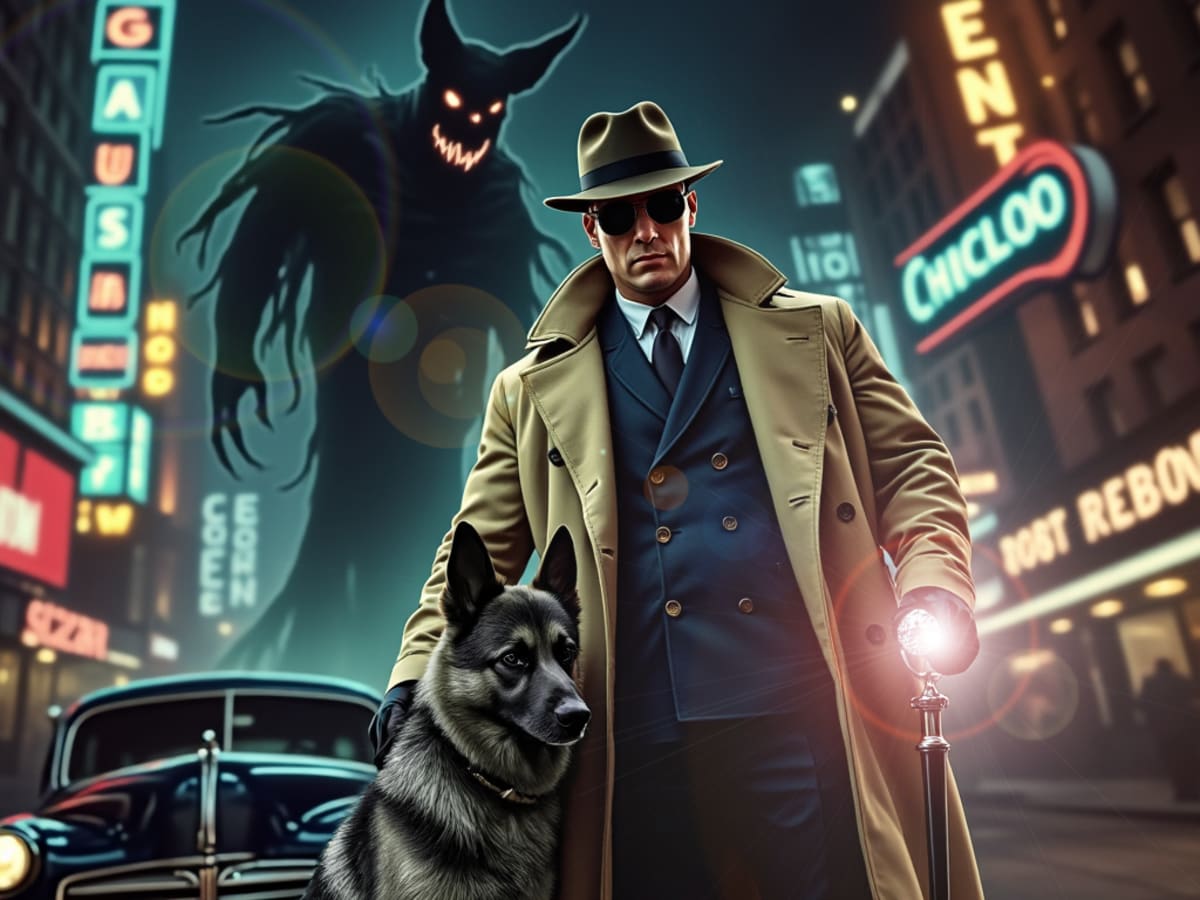
The Spectral Detective is back on track, and the hero and his dog have been a feature of this newsletter from the start; it's time to revisit the 1940s for this tale of daring do.
King in the Dark
In the fading shadows of World War II, Captain Arthur King, a seasoned OSS operative, leads a daring raid into Nazi Germany’s Thuringian Forest, targeting a clandestine SS stronghold. A catastrophic explosion during the mission robs him of his sight but awakens a haunting new gift: the ability to see beyond the veil of reality. Returning to a post-war United States, King wrestles with his blindness and the spectral visions that feel more like a curse than a blessing, isolating him in a world he can no longer trust.
Confined to a Stateside sanatorium, King’s fragile recovery is shattered when a chilling mystery unfolds within its wards. Forced to confront the unseen forces lurking in the shadows, he begins to harness his strange new abilities to unravel the truth. Only then, with the aid of a spirited puppy named Scoot, does King find a new purpose, stepping into the gritty streets of 1945 America as a private investigator. King in the Dark is a gripping prequel to the Spectral Detective series, weaving historical noir with supernatural suspense—a tale of loss, redemption, and the courage to face the unknown.