Friday Newsletter, or Trusting the Reader (Even When AI Doesn’t)
1. Use the time of a total stranger in such a way that he or she will not feel the time was wasted.Respect your reader’s time—make every moment count.
The first rule of ‘write club’, according to Kurt Vonnegut.
Often called his “Creative Writing 101” his advice totals eight, however, I’ve been working through these rules like a beauty queen’s results—in reverse order,
So at last dear reader, we’re finally at rule one.
The Golden Rule: do unto others as you would have them do unto you.
Respecting the reader, amounts to this.
In a way, this is the ring to rule them all, the other seven rules.
2. Give the reader at least one character he or she can root for. Give the audience someone to care about and invest in emotionally.
3. Every character should want something, even if it is only a glass of water. Desire drives characters and keeps the story moving. No one should feel passive.
4. Every sentence must do one of two things—reveal character or advance the action. Cut anything that doesn’t serve these purposes. No filler.
5. Start as close to the end as possible. Jump into the heart of the story quickly; minimize unnecessary setup.
6. Be a sadist. No matter how sweet and innocent your leading characters, make awful things happen to them—in order that the reader may see what they are made of. Test your characters through conflict to reveal their true nature.
7. Write to please just one person. If you open a window and make love to the world, so to speak, your story will get pneumonia. Write for a specific audience (even if it’s just yourself or one imagined reader) rather than trying to appeal to everyone.
8. Give your readers as much information as possible, as soon as possible. To heck with suspense. Readers should have such complete understanding of what is going on, where and why, that they could finish the story themselves, should cockroaches eat the last few pages. Be generous with context early on—clarity and understanding trump artificial mystery.
By this I mean that each subsequent rule is about how — to respect the reader — in a more specific way.
The first, or golden rule, becomes a measure by which all other rules can be judged, not only Vonnegut’s eight, but other examples of writing advice, which there are many, and I’m sure I’ll pontificate about the advice or more successful and adored authors than me, again.
There’s another source of advice in the modern era, which I’ve been using in its nascent form since Word first started underlining my waterlemons with red for spelling, and later blue and green… tools that’ll paint my text in a rainbow.
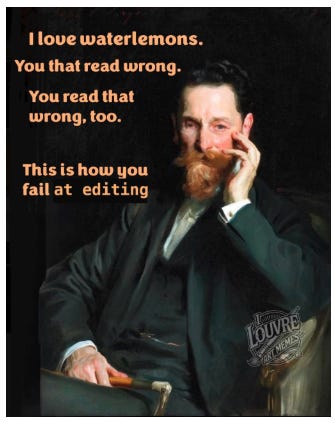
However, that’s old-school already, as the new kid on the block is Artificial Intelligence; these Large Language Models can, by comparing my writing using pattern recognition, create the illusion of intelligence and provide textual analysis, not just correction but criticism.
I’ve tried a few… but I’ll cut to the chase.
They don’t respect you, the reader, not in my estimation. Don’t get me wrong, they can offer good advice, but it’s a mixed bag; as varied as AI image generation—where you can find a great image among a bunch of ones that aren’t.
It’s crucial, if you use AI for text-checking, to be confident enough in your own vision to disregard the bad takes, while being humble and self-aware enough to recognise when the criticism lands.
Perhaps AI will soon get better, making this critique obsolete, but we’re not there yet.
So, how does AI fail to respect the reader?
It just doesn’t get it. Often, the same issues crop up; more often, it misses why something must be a mystery to the reader, or why something magical happens, flagging these core plot devices as plot holes.
AI is not human; it’s not sapient; it can’t read text like a soul can.

I wrote a short story in 2023, revisited it, checked for waterlemons (there were a few), and asked the best analytical AI, in my estimation, Grok, what it thought.
It identified a section as clunky; I asked, out of curiosity, “How would you fix it?”
The resulting text read flatter; for me, it felt dumbed down, albeit easier to read—perhaps, but something else happened… A key plot point—deleted, the entire flash fiction story hung on a premise that terraforming Mars would take centuries, so the ‘powers that be’ sought a faster solution; the rewrite excised this reveal.
Revus’s brows narrowed. “Politics demands results; waiting generations for terraforming... is difficult to sell, Lieutenant Bennett
The AI prioritised a simpler structure for a dumber reader over the story itself; it didn’t trust them to navigate the more complex text. Dialogue, interspersed with a basic description of an on-screen environment, all while deleting a single line which supported the tale’s logical core.
For a writer, trusting you, dear reader, means taking risks; it means I have to believe in you!
You’re smart; you will pick up on the subtext, and you’ll understand subtle cues. That you will appreciate a story that reveals as much as possible as soon as possible, but does not reveal all straight away.
My calling? That’s making sure I’m not wasting your time, so you turn the page.